How Dissolved Air Flotation Works: Micro-Bubble Generation
Micro-bubble physics, coagulation chemistry, and 25 years of engineering refinement — combined to consistently deliver 90–99% TSS removal.
What Is Dissolved Air Flotation?
Dissolved air flotation is a water clarification process that uses millions of microscopic air bubbles to float contaminants — suspended solids, fats, oils, and greases — to the surface of a clarification tank, where they form a consolidated float layer that is mechanically skimmed and removed.
The principle sounds simple. The engineering behind it is not. The size of the bubbles, the recycle ratio, the contact time, the coagulant chemistry, the tank geometry, and the skimmer design all determine whether a DAF system delivers the removal efficiency your discharge permit requires — or fails to meet it.
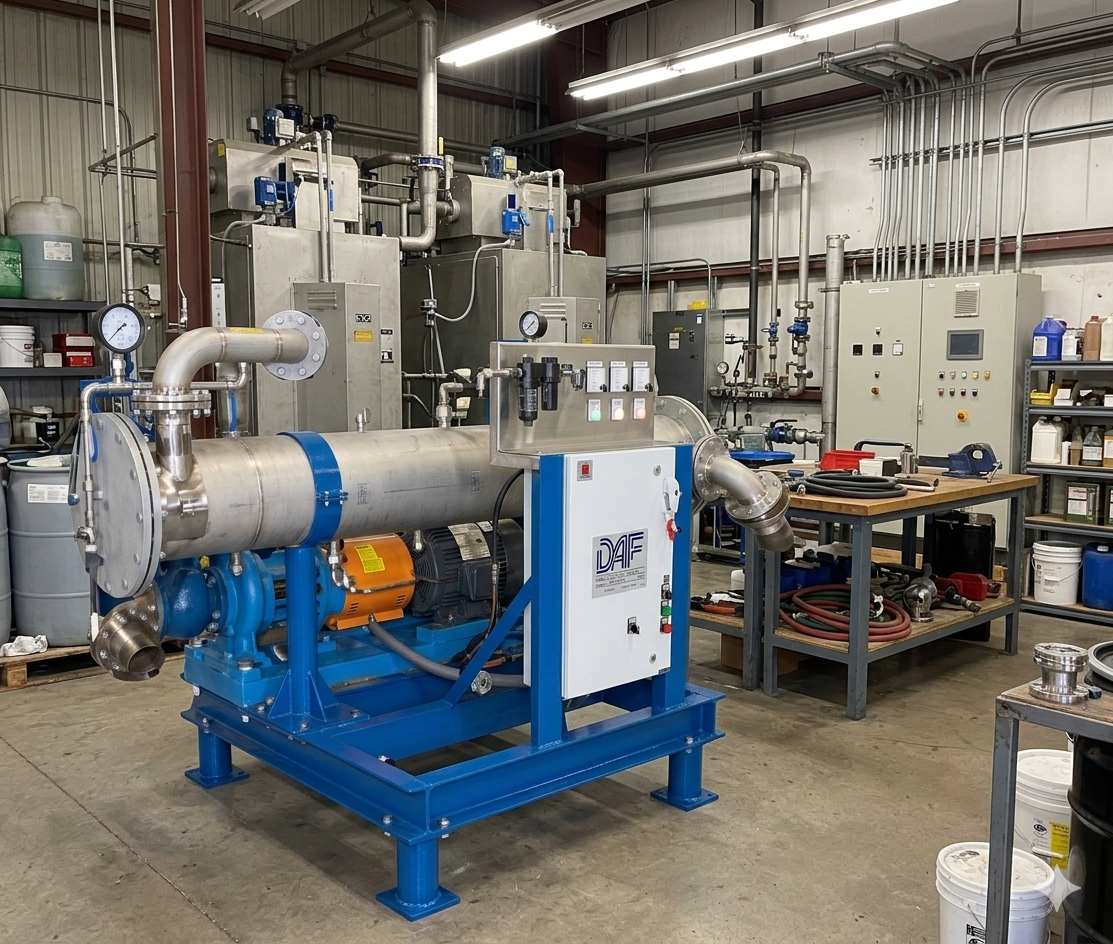
DAF Corp has spent 25 years perfecting every one of these variables. Our systems consistently achieve 90–99% TSS removal across food processing, dairy, municipal, oil and gas, and industrial applications — because we start with lab analysis of your actual wastewater before we design anything.
Request Lab AnalysisPerformance Specifications
- Flow Rate Range
- 5 – 11,000 GPM
- TSS Removal
- 90 – 99%
- Bubble Diameter
- 10 – 30 microns
- FOG Removal
- Up to 99%
- Hydraulic Loading
- Up to 4 GPM/ft²
- Recycle Ratio
- 10 – 30%
- Operating Pressure
- 60 – 90 PSI
- Materials
- 304 / 316 SS, Carbon Steel
Get Your Free Consultation
DAF Corporation works with food processors, municipalities, dairy operations, and industrial facilities across North America to solve complex wastewater challenges. Our process begins with your water — not a catalog.
Book an AppointmentWhy Micro-Bubble Size Matters
The efficiency of a DAF system is directly determined by bubble size. Larger bubbles rise too fast to attach to fine particles. DAF Corp's pressurization and nozzle design produces bubbles in the 10–30 micron range — smaller than a human hair — creating the perfect buoyancy profile to lift even colloidal particles and emulsified oils that conventional clarifiers cannot capture.
Our proprietary recycle pressurization system dissolves air into a recycle stream at 60–90 PSI. When that stream is introduced into the flotation tank through precision release valves, the sudden pressure drop causes the dissolved air to form a cloud of billions of micro-bubbles per liter — a bubble density that maximizes particle-bubble contact across the full contact zone.
The DAF Process Explained
From influent wastewater to clarified effluent, a properly designed DAF system executes six distinct and interdependent treatment steps.
Influent Screening & Pre-Treatment
Raw wastewater enters through a screening stage that removes large debris, protecting downstream equipment. Depending on application, equalization and pH adjustment may occur at this stage to condition the wastewater for optimal chemical treatment. Proper pre-treatment is foundational — without it, coagulant chemistry cannot perform as designed.
Chemical Coagulation
Coagulant is dosed into the influent stream at a precisely controlled rate determined by our laboratory jar testing. The coagulant destabilizes the electrostatic charge that keeps colloidal particles suspended, allowing them to begin forming larger aggregates. Getting the coagulant type and dosage right is the single most important factor in DAF performance — this is why we never skip the lab analysis step.
Flocculation
The coagulated wastewater enters a flocculation stage where gentle, controlled mixing causes the destabilized particles to collide and form larger, more buoyant floc. The mixing intensity and detention time are critical — too aggressive and floc breaks apart; too slow and particles never reach the optimal size for bubble attachment. DAF Corp engineers size the flocculation zone for each specific application.
Micro-Bubble Injection & Contact Zone
Pressurized recycle water saturated with dissolved air is released through precision nozzles at the inlet of the flotation tank. The sudden pressure drop releases billions of 10–30 micron bubbles that rise through the contact zone, attaching to floc particles and rendering them buoyant. The contact zone geometry, recycle ratio, and bubble distribution determine how completely particles are captured before they enter the separation zone.
Flotation & Float Layer Formation
Bubble-particle aggregates rise to the surface of the flotation tank, forming a consolidated float layer (sludge blanket) that accumulates above the clarified water. The float layer is mechanically skimmed by a rotating flight system at a rate calibrated to your system's solids loading — ensuring the float layer stays dense and the clarified zone beneath stays clean. Proper skimmer timing is critical to maintaining effluent quality.
Clarified Effluent Discharge
Clarified water exits through a submerged effluent launder at the outlet end of the tank, drawn from below the float layer to ensure the clearest possible effluent. The effluent can then proceed to polishing filtration, discharge, or water reuse depending on your permit requirements. A portion of the clarified effluent is diverted back as recycle flow to the pressurization system, completing the DAF cycle.
See How This Process Works for Your Facility
Every DAF system starts with a laboratory analysis of your specific wastewater. Send us a sample and we'll tell you exactly what your system needs — before you commit to anything.
DAF Technology Overview
Watch a complete walkthrough of dissolved air flotation technology — from influent to clarified effluent discharge.
Typical Removal Efficiency by Contaminant
Performance achieved with properly designed coagulant chemistry and optimized operating parameters. Results vary by wastewater composition — contact us for application-specific data.
| Contaminant Type | Industries Affected | Typical Removal | Best Case Removal |
|---|---|---|---|
| Total Suspended Solids (TSS) | All industries | 90–95% | 99% |
| Fats, Oils & Greases (FOG) | Food, dairy, meat, fish | 85–95% | 99% |
| Emulsified Oils | Oil & gas, metalworking | 80–92% | 97% |
| Biological Oxygen Demand (BOD) | Brewery, food, municipal | 40–70% | 80% |
| Algae | Municipal, aquaculture | 90–98% | 99% |
| Fibrous Solids | Paper & pulp, textile | 85–95% | 98% |
| Colloidal Particles | Industrial, municipal | 75–90% | 96% |
| Phosphorus (with chemical precipitation) | Municipal, food | 80–95% | 98% |
Frequently Asked Questions
Technical answers to the questions we hear most often from plant managers, engineers, and project owners evaluating dissolved air flotation.