
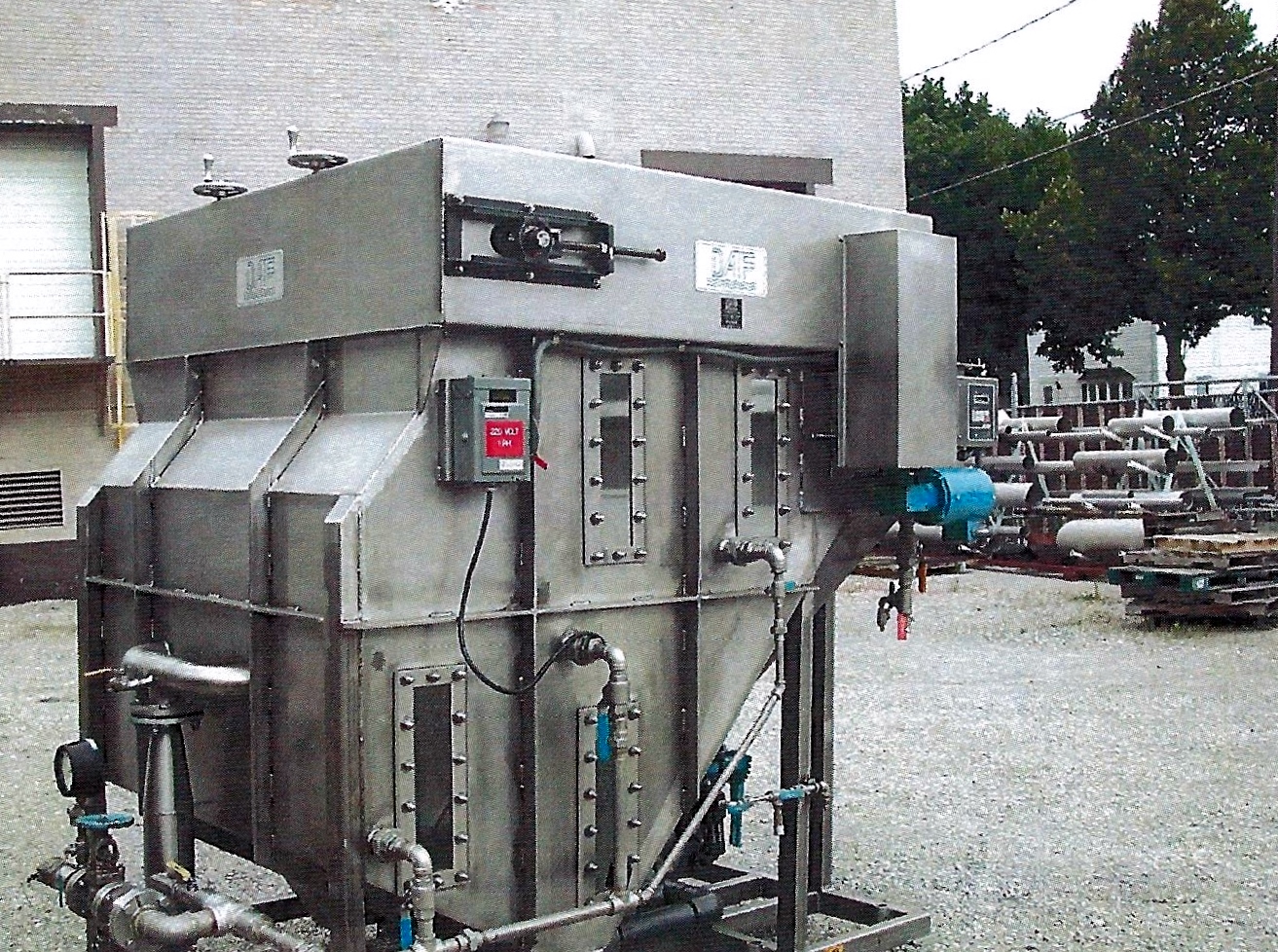
Both round and rectangular Dissolved Air Flotation (DAF) clarifiers use the same core mechanism: fine micro-bubbles attach to suspended solids and oil/grease and lift them to a floating layer for removal. When properly designed, both configurations can achieve high removal rates. The meaningful differences are mainly hydraulic and mechanical, and they drive tank size, footprint, and long-term maintenance.
Where DAF Corporation's FC Maximizer Fits In
DAF Corporation's FC Maximizer is our round, zero-velocity clarifier line, built around the hydraulic advantages described below. Its rotating inlet is synchronized to match tank rotation, creating a near-still separation zone that allows a shallow tank profile and short retention time, meaning a smaller physical footprint and lower installed tank volume than a rectangular unit sized for the same flow. The rotating skimmer is a continuous, single-mechanism design, meaning fewer wear components in routine service than a multi-part chain-and-flight system. For customers prioritizing a compact installation, faster commissioning, and a simpler mechanical maintenance profile, the FC Maximizer is typically our recommended starting point. Contact your DAF Corporation representative for FC Maximizer performance guarantees and sizing for your application.
Performance at a Glance
| Performance Metric | FC MaximizerRound, Zero-Velocity | UnimaxRectangular |
|---|---|---|
| Hydraulic Retention Time | 2–5 minutes | 15–45 minutes |
| TSS / FOG Removal | Up to 99% (90–99%) | Typically in the 90% range |
| Tank Depth (typical) | 1.3–2.6 ft (16–31 in) | Deeper, multi-foot |
| Structural Weight Loading | ~150 lb per sq ft | Substantially higher per sq ft |
| Float / Sludge Solids | Generally higher (mfr.-reported) | Generally lower (mfr.-reported) |
Removal-rate and float-solids ranges are typical figures reported by equipment manufacturers and can vary by influent characteristics, chemical conditioning, and specific design. Treat these as general guidance rather than universal constants.
Hydraulic Retention Time and Footprint
Round (Zero-Velocity) DAF
The FC Maximizer's rotating inlet mechanism is synchronized to the tank's rotation, creating a near-still "zero-velocity" zone. This lets bubbles lift solids with minimal travel distance in a shallow tank (roughly 1.3–2.6 ft), shortening retention time to a few minutes and reducing tank volume for a given flow. This hydraulic advantage is engineered into every FC Maximizer unit.
Rectangular DAF
Water moves along a longer horizontal path in the Unimax, which typically requires a longer retention time (commonly 15–45 minutes) to let bubbles separate solids before the flow reaches the outlet. Rectangular units are well suited to modular, side-by-side layouts and can share common walls between units, a real space and construction-cost advantage in tight plant layouts.
Net Effect
Round zero-velocity units generally need less tank volume per unit of flow. Rectangular units generally need less total plan area per unit of flow when arranged in banks, because they can be built wall-to-wall. Because rectangular tanks are built deeper to hold the longer retention time, they carry more water volume, and therefore more structural weight, per square foot of plan area than a round unit. The FC Maximizer's shallow, 1.3–2.6 ft profile keeps structural loading to approximately 150 lb per square foot, meaningfully lighter than a rectangular tank sized for comparable flow. That matters for slab design, elevated installations, or sites with limited foundation capacity.
Hydraulic Stability and Flow Distribution
This is where the FC Maximizer's zero-velocity design shows its biggest advantage. In a conventional linear-flow tank, rising micro-bubbles have to fight a horizontal cross-current the entire time they're lifting a particle, which is exactly the condition that lets dead zones and premature breakthrough creep in. The FC Maximizer's synchronized rotating inlet removes that cross-current: because the inlet rotation matches the water's own rotation, the water is effectively still relative to the tank, so bubbles travel straight up with nothing pulling them off course. That's a structural advantage built into the mechanism itself, not just careful baffling layered on top of a design fighting its own flow pattern. Flow distribution in any clarifier still benefits from good inlet, outlet, and baffle design, but the FC Maximizer starts from a hydraulic condition, near-zero relative velocity, that a linear-flow tank simply cannot replicate.
Sludge and Scum Handling
Rectangular units typically use a chain-and-flight scraper that drags float and settled solids along the tank length to a hopper. The FC Maximizer's continuous rotating skimmer sweeps the float layer smoothly around the tank perimeter without dragging water through it, producing a thicker, more concentrated float than a dragged-scum approach typically achieves.
Maintenance Considerations
The FC Maximizer's rotating skimmer is a single, continuously moving mechanism, one drive, one seal set, one bearing assembly, turning smoothly around a fixed center point. There's no chain to track, no flights to align, and no sprockets to keep in tension. A chain-and-flight system, by contrast, has many more wear points spread across the full length of the tank: chains stretch, flights wear unevenly, and sprockets need periodic tension checks, all of which add up to more inspection points and more parts on the replacement schedule over the life of the unit. For plants that want to minimize the time technicians spend on routine mechanical upkeep, the FC Maximizer's single-mechanism design is a meaningful long-term advantage.
Choosing Between Them
- Limited plot space, need to bank multiple units together, or a preference for simpler civil construction: rectangular (Unimax) is often favored.
- Minimizing tank volume and footprint for a given flow, or wanting a single-mechanism skimmer with a simpler maintenance profile: round (FC Maximizer) is often favored, and it's purpose-built for this case.
- Either configuration can meet high removal targets when properly sized, chemically conditioned, and fitted with appropriate internals. For a shorter retention time and the simpler upkeep of a single rotating mechanism, the FC Maximizer is the clear choice.
This summary is intended as general orientation. Site-specific removal efficiency, sizing, and maintenance costs should be confirmed with DAF Corporation design data and, where possible, pilot testing on your actual wastewater stream.
Frequently Asked Questions
Which is more efficient, a round or rectangular DAF clarifier?
Both can hit high removal rates when properly designed, but round zero-velocity units like the FC Maximizer typically achieve higher TSS/FOG removal (up to 99%) with far shorter retention time, 2–5 minutes versus 15–45 minutes for rectangular units.
How much floor space does a round DAF need compared to rectangular?
A round zero-velocity unit generally needs less tank volume per unit of flow. Rectangular units can be more space-efficient when several are banked wall-to-wall, since they can share common walls.
Which DAF clarifier is easier to maintain?
Round units with a single rotating skimmer mechanism (one drive, one seal set, one bearing assembly) generally have fewer wear points than rectangular units, which use a chain-and-flight scraper with more inspection and replacement points.
Not sure which configuration fits your flow and footprint?
Talk to a DAF Corporation engineer